
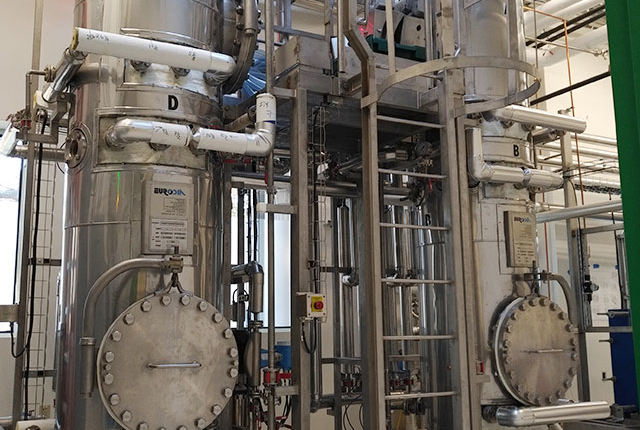
Chromatography and bipolar electrodialysis
Eurodia has an unrivaled mastery of these two technologies, which are key to bio-based chemistry.

Reducing greenhouse gas emissions by using renewable raw materials, minimising environmental impacts at source, developing materials with new properties, creating value and employment, accelerating the circular economy, responding to consumer demand — there are many compelling reasons to reduce chemistry’s dependence on hydrocarbons.
Valorising biomass, developing solutions capable of capturing CO₂, purifying molecules derived from renewable carbon transformation, decarbonizing chemical processes using high-yield, low-environmental-impact approaches — this is the challenge on which Eurodia has been building its expertise for several years, with solutions combining various types of membrane technologies, chromatography, and ion-exchange processes.
We have developed strong expertise …
• Biomass valorization: our processes purify cellulosic (C6) and hemicellulosic (C5) sugars, which are the raw materials for various fermentations and enzymatic / catalytic reactions enabling the production of bio-based molecules.
• The electrification of existing chemical processes,thereby contributing to their decarbonization. Our conventional and/or bipolar electrodialysis (BPED) technologies allow fossil energy to be substituted with electricity, reduce or eliminate the effluents generated, and valorize the co-products of chemical reactions.
• Controlled management of carbonate/CO₂ equilibria — essential in most direct carbon capture processes, whether atmospheric (DAC — Direct Air Capture) or marine (DOC — Direct Ocean Capture) — is one of the key strengths made possible by bipolar electrodialysis (BPED).
• Purification of biobased molecules (downstream processing, DSP): Eurodia’s technologies are used downstream of fermentation operations, raising the grade of bio-based molecules (organic acids, amino acids…) to the standards of secondary-processing industries (biobased and biodegradable plastics, alternatives to conventional plastics, green detergents and solvents, etc.).
• Production of organic acids: starting with various agricultural raw materials, Eurodia’s processes make it possible to obtain: the lactic acid used in the agro-food industry and in making biodegradable plastics (PLA); succinic acid (a platform molecule useful for developing other molecules and specialty composites: polymers, resins, etc.); acetic acid for various applications (biosolvents, preservatives, antiseptics…); gluconic acid, a chelating agent used particularly in biodetergents; and many others