Technical efficiency
Choose ED for demineralization and you drastically reduce the use of chemical inputs compared to any other chemical or ion-exchange process

Electrodialysis is a technique that uses ion-exchange membranes to extract mineral or organic ions from a solution.
Under the influence of an electric field, these membranes act as a thin selective barrier that makes it possible to demineralize, purify and/or concentrate the fluids being treated. If a certain type of membrane is used, this technology also allows the effluent-free production of acids and bases from saline solutions.
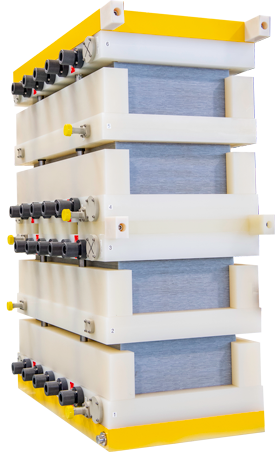
Conventional electrodialysis
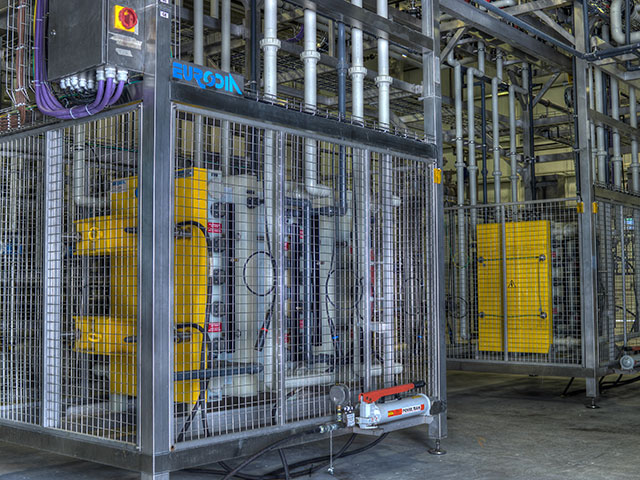 This technology makes it possible to demineralize, purify, and/or concentrate fluids.
The process works using monopolar ion-exchange membranes, composed of a polymer matrix containing functional groups that are positively or negatively charged. When subjected to a difference of electric potential, these membranes behave like selective ionic conductors, letting anions or cations through.
Bipolar membrane electrodialysis
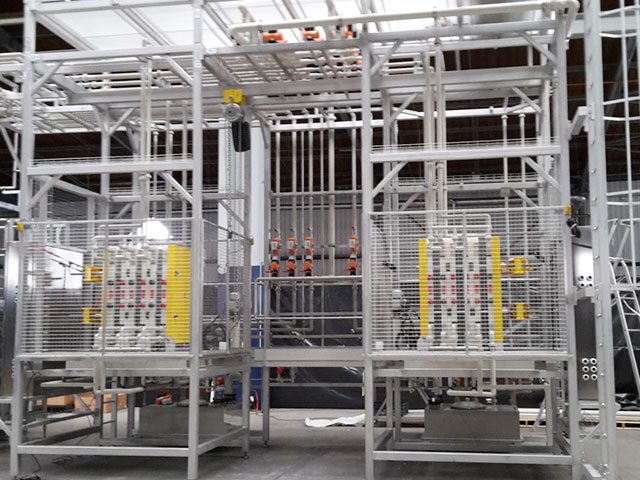
This technique splits water to convert saline solutions into acids and/or bases.
Used as a complement to monopolar membranes, bipolar membranes serve to split water. When combined with monopolar membranes in various configurations, they can produce an acid and/or a base from a (mineral or organic) saline solution.
With Electrosynthesis Company Inc., based in Lancaster, NY-USA we expand our offer for feasibility and piloting of ED based process solutions on the North-American market & Mexico.

Electrodialysis is used in many processes that require demineralization, concentration, or the separation of ionic components.
The main applications are…
whey demineralization: electrodialysis is combined with other technologies in Eurodia’s patented processes. These allow the production of serums with different grades of demineralization – up to 90%, to obtain a key ingredient of infant formula.
pH adjustment of juices: bipolar membrane electrodialysis is used to precisely reduce or increase pH without any chemical inputs.
the lithium industry: bipolar membrane electrodialysis converts lithium salts into lithium hydroxide, which is needed to make electric batteries. The same technology also makes it possible to recycle various mineral salts co-produced during battery manufacture, and thus to reduce your environmental footprint.
purification of sweetened juices, for which Eurodia has developed various processes including high-temperature electrodialysis
Generic advantages of electrodialysis
Advantages of Eurodia electrodialysis
Combinable with our other processes to solve each industrial challenge with a turnkey, custom process solution that guarantees eco-efficiency: quality, production cost, effluent reduction and/or valorization.
A very wide range of stacks, adaptable to multiple capacities and applications.
Automatic clean-in-place (CIP) of the reactors.
Our built-in spacers, the thinnest on the market and covered by Eurodia patents, minimize energy use and offer higher desalination capacity.
Controlled hydrodynamics for optimized separation performance.
Stacks have optimal sealing and mechanical integrity, allowing high-value-added fluids to be processed without contamination.